Where were their Mothers?
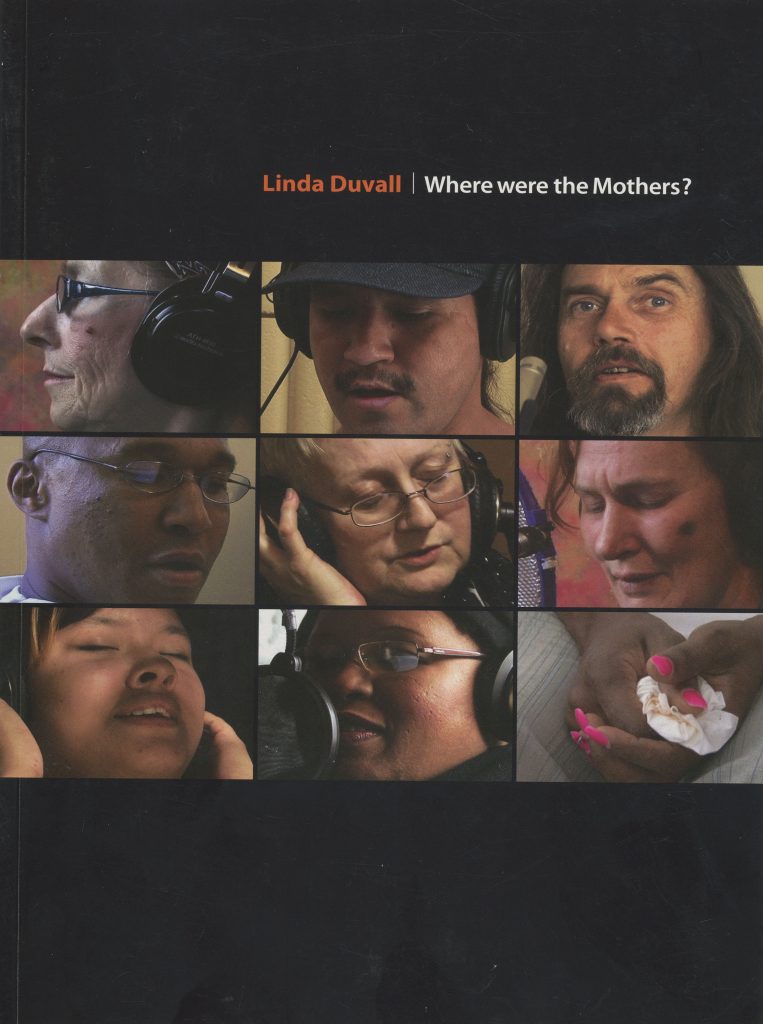
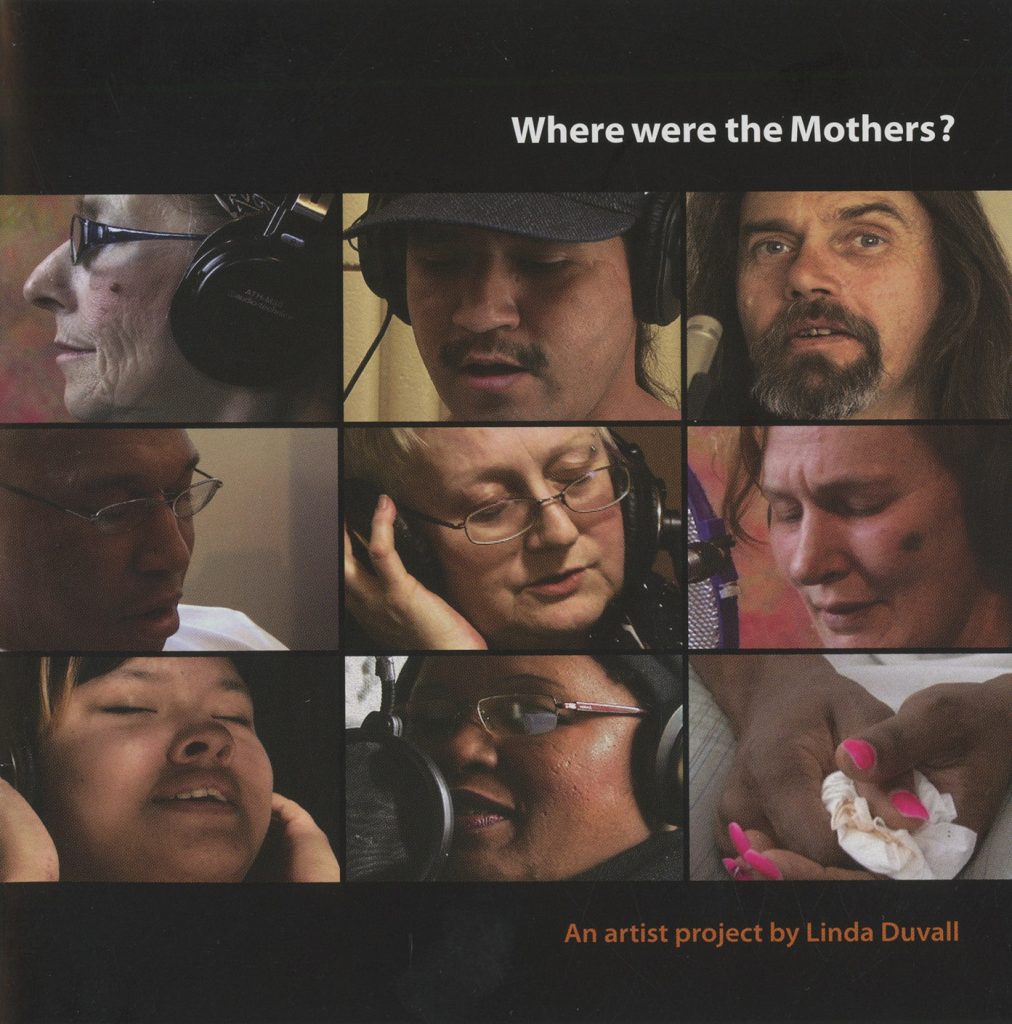
Linda Duvall’s Where Were the Mothers? is a multimedia exhibit that explores the uneasy fluidity of truth, and reveals the contradictions in trying to assert a singular or absolute narrative. “We are deluged by reports of violent acts and seemingly senseless criminal activities, and we often look for someone to blame,” Duvall says. A common response is ‘Where were their mothers?’ Duvall explores the assumptions behind this phrase by focusing on the relationship between “people who have taken alternative life paths” and their mothers.
The exhibit presents the complicated narratives of people who have had run-ins with the law, lived or worked on the street, dealt with addictions or participated in illegal street gangs. Each of these participants collaborated with a professional musician to produce an original song about their mother. Condensing a lifetime of stories into three minutes of music both compresses and alters the original narratives. Duvall juxtaposes videotaped excerpts of the song production process alongside the finished songs.
A second layer of complication results from the staging of the encounter between two strangers – in this case the participant and the musician. Thorny issues of roles and authorship emerge. Who really shaped each song, and what preconceptions were brought to the interaction by each party?
The exhibit also includes Duvall’s interviews with other mothers whose offspring have deviated from conventional paths. Areas of discussion include issues of blame, available support systems for mental health or addiction needs, and the secrecy surrounding such stories.
Catalogue
Events
Where were the Mothers has been presented at:
Art Gallery of Mississauga, Mississauga 2009
Adelaide Resource Centre for Women, Toronto (launch of CD) 2009
Dunlop Art Gallery, Regina 2010
Toronto Dismas Fellowship for Ex-Offenders – Toronto 2010
White Buffalo Youth Lodge, Saskatoon (co-presentation with Mendel Art Gallery) 2010
“Journeying Through Grief”, Grief Training Program, Jane and Finch, Toronto 2010
Aboriginal Funders Event hosted by Saskatchewan Arts Board, Saskatoon 2010
Gang Prevention Forum, Western Development Museum, Saskatoon 2010
Community Memorial and Celebration of Life, Jane Finch Community, Toronto 2010
Social Work Program, First Nation University of Canada, Saskatoon 2010
Str8-Up Saskatoon, 2021
Essays
A long time coming by Peggy Gale
Singing the Abject and Listening Obliquely by Rubén Gaztambide-Fernández
Engaging Strangers by David Garneau
Related Articles
Visit the article Difficult stories shared in Saskatoon artist’s songwriting project
by Jeanette Stewart, The Star Phoenix
Article Text – Difficult stories shared in Saskatoon artist’s songwriting project By Jeanette Stewart
By Jeanette Stewart
for The StarPhoenix
Just singing a song may not change the world, but it could help the lives of one group of aboriginal women in treatment for drug and alcohol abuse across Canada.
A University of Saskatchewan researcher has envisioned a unique way to tell a story of addiction and recovery through songwriting — taking women “from stilettos to moccasins” as they re-claim their aboriginal identity.
“This is a means and a mechanism for their voices to be heard,” said Colleen Dell, an associate professor and research chair in substance abuse at the U of S.
Her four-year project focused on collecting stories of more than 100 women in treatment for drug and alcohol abuse across Canada in a partnership between three agencies — the University of Saskatchewan, Canadian Centre on Substance Abuse and the National Native Addictions Partnership Foundation (NNAPF).
At a workshop at Blackstrap Lake last month, Dell gathered 30 research participants, addictions researchers and treatment workers to collaborate with Prince Albert-based singer-songwriter Violet Naytowhow, a Woodland Cree artist from the Sturgeon Lake First Nation.
Naytowhow will compose and produce a song to accompany the stories.
“Unless people feel, sometimes they don’t get it,” Dell said. “Song would be one way to get it.”
The study is designed to fill a gap in addictions treatment and research. Across Canada there are few treatment centres and little research dedicated solely to addictions in aboriginal women.
“We need to have something more specific,” said Sharon Clarke, executive director of the NNAPF.
“The women spoke highly, and with a lot of reciprocity, of wanting to share their stories and what they’ve learned, so they didn’t go through all they went through to just heal for themselves,” Dell said.
She says some of the women in the treatment centres were learning for the first time about their aboriginal culture and dealing with the racism, bullying and discrimination that had followed them throughout their lives. Prevalent in the stories was the role of trauma, abuse and discrimination. One woman, who inspired the title of the song, said she was hanging up her stilettos for her culture, in reference to giving up a life of prostitution.
“When we gave some of the information to Violet to look at, she said, ‘You don’t have a song here, you have an album. You have a couple albums,'” Dell said.
Naytowhow, a Canadian Aboriginal Music Award-nominated singer and a recovered addict herself, plans to produce a single based on the lyrics penned at the workshop.
She said the story the women put together acknowledges both how they went through their healing and their value in society — sometimes for the first time.
Naytowhow equates anticipation for the song’s release to that of having a baby. “It’s like the birth of a new child,” she said.
Primary findings from the project include a fact sheet for care providers specific to aboriginal women’s healing. A DVD of the Blackstrap Lake workshop is almost finished, and the researchers are working on pamphlets and guide books to get their findings out to the general public. When the entire project is complete, they will use tools such as social networking sites to make the song and video accessible to the public.
The group effort and the variety of delivery methods for the project results is an attempt to ensure the findings won’t just sit on the shelf. The partnership with the two centres and other experts will ensure the research can make its way to meetings and policy discussions.
“It’s so important to have the decision-makers . . . they’re the people who sit at those tables and help influence those decisions,” Dell said.
The tools created through the research will be used within national Native alcohol and drug abuse treatment centres to provide programming specific to women.
Read Bart Gazolla’s comments in his THE A WORD blog
Click here to read article- Road Tripping to Regina – Bart Gazolla
Road tripping to Regina…..
May 22 2010 Categorized Under: Reviews
Regina, is not, like the song says, my beautiful town: but then, neither is Saskatoon, hah, where 75% rent increases are touted as “normal” or the “market correcting itself”, to quote several City Councillors, whose stupidity is so pervasive that to even begin to speak about it would hijack this entry. But that’s okay: given a choice between Atch and Fiacco, I would choose not to decide, to quote Geddy Lee.
I say all this as I was recently in Regina, for two reasons, really: one was to tag along on the trip by a number of the Mendel Art gallery staff to the MacKenzie, for the reception for the opening of James Henderson, Wicite Owapi Wicasa, “the man who paints old men”, but also as Linda Duvall’s exhibition “Where were the mothers?” was soon to close at the Dunlop, and I wanted to see this installation, for a variety of reasons.
Friday night was the MacKenzie: alot of meat, and I have never eaten that much venison, and I must say that the MacKenzie throws an okay party (the drummers were wonderful, all the speeches were short, and the last speaker, in talking of StarBlanket, his legacy and this place, spoke with such warmth and honesty, touching on how wonderful that so many have worked so hard to honour Starblanket – continuing what Henderson began – that there are many good people here…and I thought again of Neil McLeod’s comments about this place, its history, and how in this place, we – white, red, black, yellow, whatever – are so much more than the past 150 years of rage and pain and genocide and denial). Good food, with much more booze (in variety ) than the Mendel, and with much more meat (yes, I know I said that already) but no where near as much fun.
Sure, I lost a game of thumb wars to Mendel Director Vince Varga (he ambushed me), and got to make faces at Dan Ring as he was speaking, but for sheer oddness and entertainment, I’ll take the Mendel (several openings ago, one of the wonderful Mendel volunteers at the bar asked me how many drinks I’d need to write a positive review – not as an insult, but in a bribe kind of way. And after the Symposium on the Henderson and Longman shows, Vince and I were told by another volunteer that we’d best drink faster, as they weren’t putting away the half open bottle of wine, we’d have to finish it – all said in a stern, maternal voice that brooked no opposition. Mendel volunteers rock.).
The MacKenzie is like a massive warehouse space, high ceilings, gov’t coloured carpet (inoffensive and bland): and frankly, I prefer the Mendel installation to this version, perhaps as the Mendel, with its smaller space, could use that to speak to the contradictions and contrasts of Henderson’s work: so his CPR stuff was separate from his Aboriginal portraits, or Hugh Richardson is kept away from his “betters” (there is a wonderful song by Bruce Cockburn, that talks of how Kit Carson’s ghost wanders the plains of America, as a punishment for what he did, his betrayals and destruction…..), and an entire side room of the Mendel had the many portraits of Flying Calf, or Starblanket, with the interactive stations for veiwers to listen to the many oral stories about these men, and their legacy, from their successors and children, literally and metaphorically.
Its always fun to go to Regina, though, even if it snows and hails, as it did: talked with David Garneau briefly about the plans by the U of S to build a new, arts focused building (as I type this, the second floor of the Murray building – the building for the Department of Art and Art History, on the U of S campus – is leaking water like a sieve into various buckets, and how we are to be part of a “new, interdisciplinary initiatve / building” as the U of S unilaterlly seeks to eliminate sessionals is unclear at best, untenable at worst, and perhaps an underhanded attempt to eliminate the Department itself – hey, just because you’re paranoid doesn’t mean they’re not out to get you), the Clarion project. Also spoke with Erin Gee and Jeff Morton, and a quick word with Elwood Jimmy: but it was a fairly staid opening, perhaps no different than here, where a local artist will bring in more than a traveling show……even if its tripe like in Through and through and through…..no, wait, that’s not fair. Tripe can be very good if well prepared. The drummers did make it seem more present and contemporary, less historical, though, and this was good – demonstrating that after a number of genocidal ventures, that “they” are still here, and doing very well, thanks for asking.
The next day was the Dunlop, as it was clear that Duvall’s work would require time: a brief conversation with Amanda Cachia, Director of the Dunlop, Friday night confirmed that, as well as a few other insights, such as her wonderful comment that they’ve had visitors more about quality than quantity, as they’ve had fewer visitors to this show, but those that spend time with it, spend a great deal of time with it, and often returned. “Where were the mothers?” definitely required time, space and focus.
The Dunlop space was filled with video projections, and headphones, mounted on the wall opposite, save for one video projection that was presented on the wall at the end of the gallery. This “prime” projection didn’t require headphones, its audio washed into the space: the others did, but looped in an acceptable amount of time, and some were very didactic, whereas the first projection on the left side of the gallery was more “artistically” shot, in that the mothers who are talking have a linked visual projection that focuses on their hands, never their faces, and that works amazingly well: the hands move, or “squirm” (too negative a word) or grasp and move, a very strong visual metaphor for the helplessness that pervades the words of the mothers.
Let me explain that: its not “helplessness” in not having voice – as they do, here. And mothers – good mothers, and these women are presented as such, and I believe that they are – are never powerless. They are often overwhelmed by their responsibilities, and the weights they carry, but the mothers here are talking about the helplessness that is implicit in the damning and damned title of the show. One can easily picture someone, in response to a crime, asking “Where were their mothers?”, and this implies much: fathers are assumed – and often are – absent, and mothers can do nothing “right” – to quote one of the mothers, if you don’t work many jobs, you’re lazy. If you do work many jobs to support your children, you’re an “absent mother”. Several commented on the stereotyping of race and crime that happened in the infamous Jane Creba case (my personal take is that it was punished so severely as it made people afraid to shop, or that it was implicitly an issue of consumers vs. non consumers, but my Marxist is showing….)
Here are some of the artist’s words, coutersy of Duvall and the Dunlop, that will fill you in on the process, and the objectives, of this show, and like many of Duvall’s past work, they bleed together, enhancing and enriching the other:
“We are deluged by reports of crimes, violent acts, regrettable incidents, and seemingly senseless criminal activity. The media presents very simplistic versions of these events – who, when, where, what. The rest of us try to make sense of what seems to be an alarming increase in crime committed in our communities. We often look for someone to blame – the system, the schools, the police, drugs, the offenders themselves. One of the most common responses is ‘where are the mothers’? The easiest approach is to dismiss these women as bad mothers, unable or unwilling to properly raise and guide their offspring.
In Where were the Mothers?, Linda Duvall has worked with professional musicians in Ontario to assist individuals who have taken alternative paths to write songs about their mothers. Duvall also gives voice to mothers whose offspring have taken paths other than what one expects for one’s adored babies. These alternative paths may include involvement with the legal system, battles with addictions, living or working on the street, or related directions. Edited excerpts from these two related processes are being prepared for a multi-channel video and sound installation to be presented at both the Dunlop Art Gallery and the Art Gallery of Mississauga, and a catalogue is being co-published by the two galleries. Each gallery presentation will include related artifacts such as preliminary lyrics and musical notations.”
Duvall’s exhibition made me sad: partly because class is still so much of an issue, here. When we cite that horrible concept that “it takes a village to raise a child” it means something other than letting the yuppies take up as much space as they want with their massive strollers, their “babytanks”, to quote a friend. Maybe it also must mean forgiveness and community and rehabilition and second chances…you know, all that “bleeding heart liberal shit” to paraphrase our federal minister for revenge that only applies if you’re the right class, or the right colour. I mean, blow and drunk driving are reserved for the ruling class, and its best we remember our places: everyone else only gets one strike…..and I might add that a society is judged by how it treats its weakest, and perhaps putting the onus on the mothers is more about blame, than “family values” and responsibility.
Click here to read article – A review of the CD Where were the Mothers? is available in Robert Francos’ column in Jersey Beat
“Where Were the Mothers?: An Artist Project by Linda Duvall” (lindaduvall.com) is a complex, yet incredibly impelling work by VARIOUS ARTISTS. She joins together established Canadian musicians with street people and others who have had a rocky life, and each pairing perform a song the musician has co-written (the lyrics are mostly by the people in trouble, and the music is written either jointly with the musician, or by one or the other. The singing talent various by person, including some with amazing voices, such as Chris and Mashyk (though not only them), and others who you can hear the absolute wear on their bodies through drugs, gang affiliations, prison, prostitution, and the like. The styles range from rap to hard rock, from folk to traditional First Nations (Native Americans). The central theme is obviously geared towards the mothers of these singers, ranging from “how could you treat me like that” to “please forgive me for my disrespect.” However, they are all touching. This is a magnificent project, and if you look up Linda’s Web site you can see/hear clips from some of these cuts, but I recommend finding out how to obtain this disk, which also comes with a DVD on how the project progressed.
A November 6, 2009 article on the exhibition Where were the Mothers? is at Mississauga News
Click here to read article – November 6, 2009 – Where were the Mothers? – Mississauga News
Julia Le
Nov 06, 2009 – 8:13
AGM opens mother of all shows
New show opens. Artist Linda Duvall is presenting her multimedia exhibit entitled Where Were The Mothers? at the Art Gallery of Mississauga. Staff photo by Rob Beintema
A unique new show that that explores the relationship between people who take different paths in life and their mothers opened last night at the Art Gallery of Mississauga at City Hall.
Where Were The Mothers? presents the life stories of people who have run afoul of the law, lived or worked on the street, dealt with addictions or belonged to street gangs. Professional musicians have translated those tales into music.
“We are deluged by reports of violent acts and seemingly senseless criminal activities, and we often look for someone to blame,” said visual and media artist Linda Duvall, who completed the exhibit last week after working on it for the last three years in Toronto and Saskatoon.
In creating the exhibit, the artist was initially attempting to answer questions about her own life.
“My son had been jailed, he’d been addicted and actually done nearly everything that the participants had done, and I knew that I wanted to talk to people who had been through similar experiences,” Duvall said during an informal discussion that followed the exhibit’s opening reception. “So I just did.”
Over three years, the project evolved beyond Duvall’s expectations.
Videos depicting the musicians working with the subjects are featured along with the songs in the exhibit. They include interviews with mothers whose children have strayed off the straight and narrow path of life.
Music producer Christian Hurst and Leroy Sinclair, whose life is examined in the exhibit, said the experience has taught them about human nature.
Sinclair talks about being abused as a child, dealing with racism and fending for himself on the streets. At first, he said, he didn’t want to rehash old memories, but now feels he can be a role model to children in similar situations.
“I feel stronger about going out and helping kids,” said Sinclair, 46, adding that it was cathartic to share his story. “I feel the more things that are out there for kids who are struggling, the more changes they will have (to live a better life).”
For Hurst, translating Sinclair’s story into a song was a rewarding experience.
The song runs for seven minutes and is a mix of hip hop, church music and reggae.
It is included in a compilation CD, which is available for purchase at the AGM.
Also opening at the AGM last night was a multimedia exhibit that examines capitalism, fair trade and the social implications of consumerism.
Made In India by Harrell Fletcher and Wendy Red Star tells the tale of the two American artists who buy a rug, but receive two by mistake. Rather than returning the extra rug, they sell it and set out to find the factory worker who made it so they can give him the $1,500 they made on the deal.
Both exhibits run until Dec. 24.